



Optical Systems Engineering · Wavefront Metrology · Simulation
Optical Systems With Predictable Performance
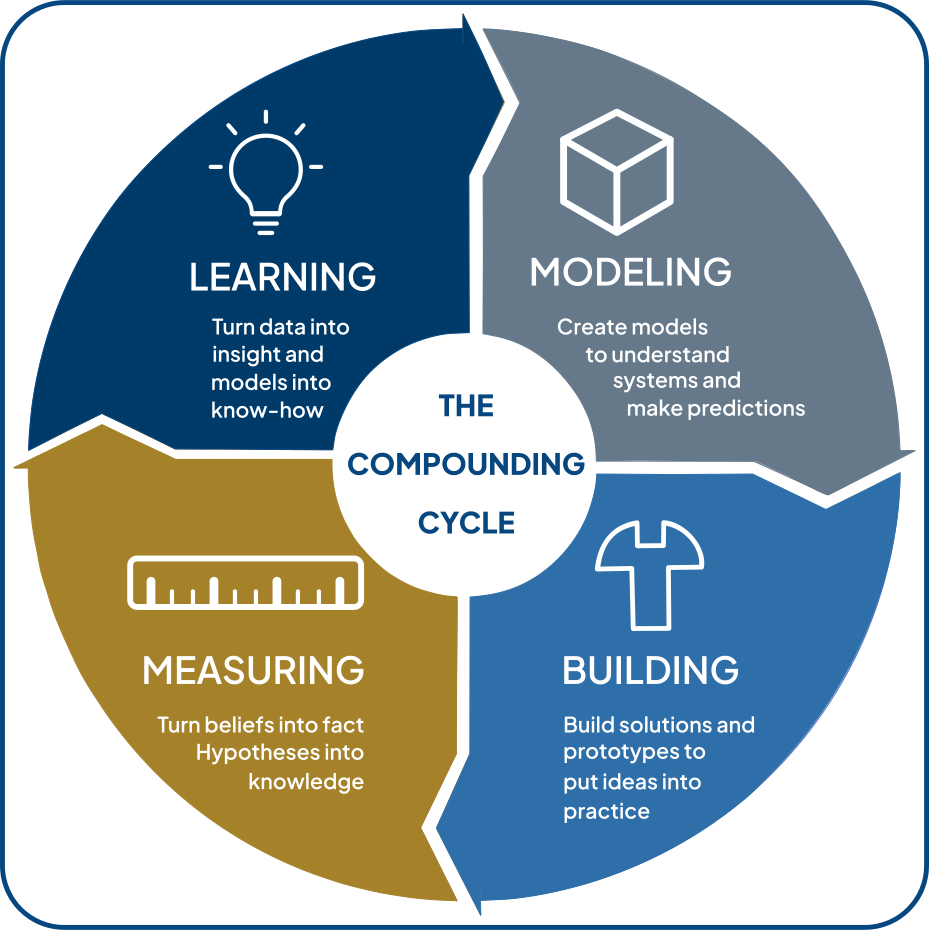
When optical systems don’t meet expectations, we need to look into assembly or expectations. When these two elements match, we help customers move the development process entirely into the computer by developing digital twins.
High-performing complex systems cannot reach their full potential with manual tweaking. It just takes too much time. With a digital twin, what takes months in the lab can be achieved in hours on the computer.
But everything needs feedback, and we close the loop with full-system wavefront metrology. Shack-Hartmann sensors and interferometers solve different needs. Senslogic supports you with both.
Core Services
Wavefront metrology & Interferometry
Alignment targets involve an awkward compromise: a small aperture is difficult to work with, while a larger one leaves too much room for error. A rail-mounted camera gives you a much clearer view of what you’re adjusting.
Our WaveMe toolbox turns that camera into an alignment tool. You store a reference position and track the beam’s displacement as you work through the optical system. Automatic exposure, annotated crosshairs and large position indicators make the feedback easy to read while you make adjustments.
Once the elements are aligned, you can move on to collimation and wavefront measurements with WaveMe’s Shack–Hartmann module, or use phase-shifting interferometry for more detailed testing with a camera and nanopositioner. That gives you measurement support from the first element through to verification of the assembled system.
We can help you choose and set up the measurement method, put WaveMe to work with your hardware, and interpret the results. If you have an optical bench that takes too long to align, or a system that never quite reaches its expected performance. That’s a good place for us to start.
Full System Modeling & Tolerancing
A lens model can tell you how the optics should perform. Understanding the finished product also means accounting for its mechanics, algorithms, calibration and the way these interact. This is where we bring three decades of system modeling experience to your project.
We start with the decision you need to make. Would tighter alignment improve the result, or could calibration recover the performance? Which manufacturing tolerances deserve attention, and which could be relaxed? Answering these questions can save both development time and unnecessary precision in production.
To do that, we simulate variations of your system and use the results to build a model of its behavior. We use Latin hypercube sampling to explore combinations of parameters efficiently, including effects that can be missed when changing one parameter at a time. You get a clearer picture of what controls performance and where there is room to improve it.
The first step can be a focused investigation using the design and measurements you already have. From there, we can develop a digital twin that supports further design choices, tolerancing and optimization. Bring us the question that is holding up your next decision; we can work out how much modeling it needs.
High-performance and GPU computing
Exploring system behavior can mean running thousands of simulations. Making those calculations faster lets you investigate more design options, refine tolerances and test ideas while they are still useful to the project.
We work with the calculation you already have and identify where the time is going. Sometimes compiled code or parallel processing with OpenMP is enough to make a substantial difference. For workloads suited to GPUs, we adapt the algorithms to take advantage of the hardware. This is a regular part of our own modeling work, and we can bring the same experience to yours.
Our litho-app gives you a working example of that performance: GPU computing makes optical simulations fast enough to explore directly in a browser. WebGPU also gives us a way to combine demanding calculations with visualization and distribute the resulting tools without a separate desktop installation.
If a MATLAB routine, simulation or data-processing task is slowing down your work, send us a brief description and its current runtime. We can assess where acceleration is likely to help and what it would take to implement.
Services By Topic
Wavefront Metrology
Shack-Hartmann systems, interferometry, calibration workflows, and integrated measurement solutions.
Optical Modeling
Performance prediction, tolerancing, coherence analysis, simulation infrastructure, and optical optimization.
Algorithm Development
Custom numerical methods, GPU acceleration, reconstruction algorithms, and scientific software tooling.
System Integration
Combining optics, software, mechanics, and diagnostics into measurable and predictable systems.
Lithography & Pattern Generators
Optical lithography, advanced imaging systems, projection optics, spatial light modulators, and illumination engineering.
Virtual Lab Infrastructure
Model-based workflows enable faster iteration cycles and reduced experimental uncertainty.